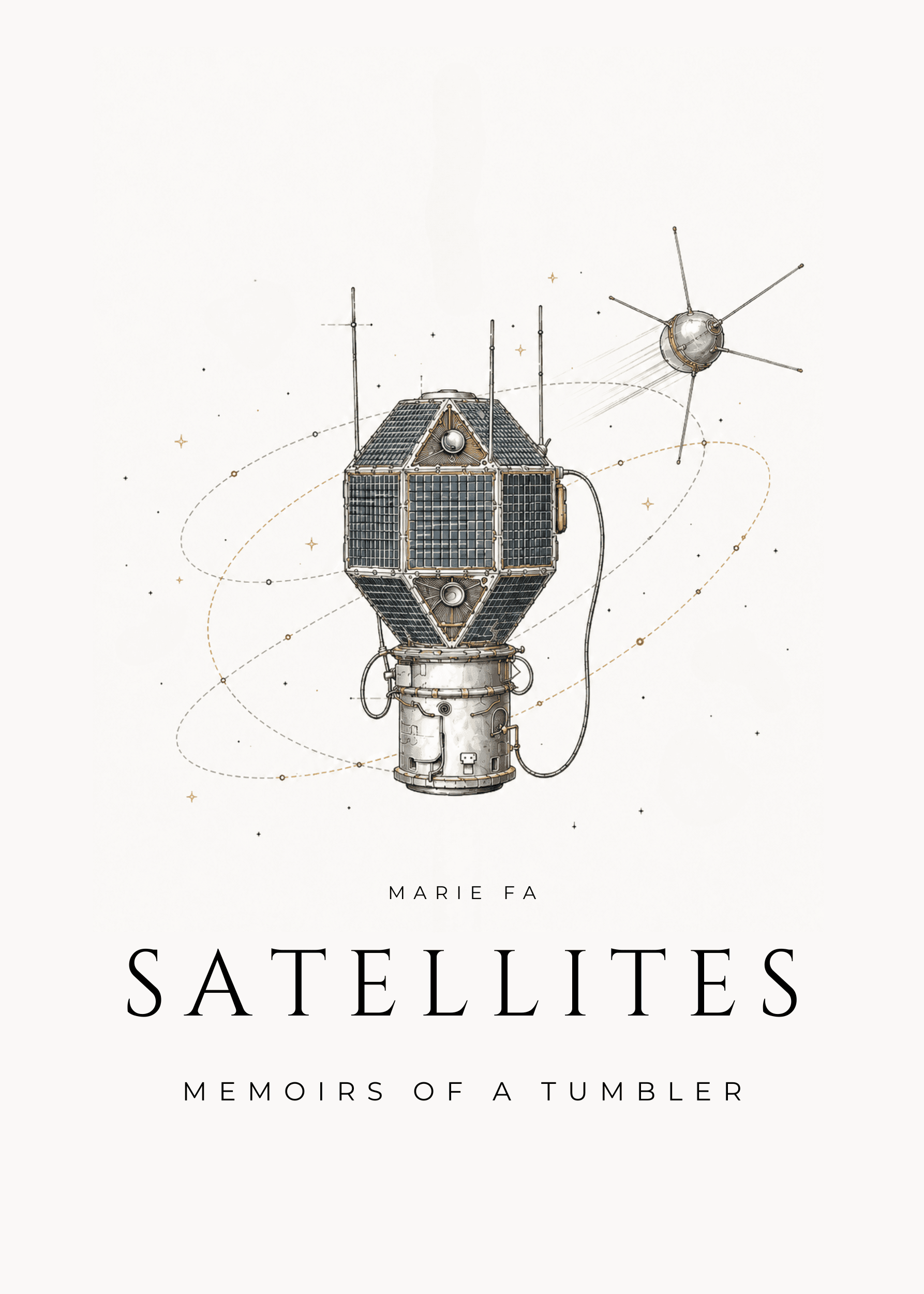
Chapter 1 — The Clean Room
Before space, there was cleanliness.
A radical cleanliness, almost pathological. The clean room at Lincoln Laboratory in Lexington, Massachusetts, runs under slight positive pressure so that air always flows from inside to out. At the entrance, a tack mat catches whatever shoes might have carried in. The coveralls are white. The gloves too. Hair vanishes under bouffant caps. Even breathing changes here, slower, more deliberate, as though every exhalation were a calculated risk.
A single dust particle in the wrong circuit can kill a satellite.
I am probably the cleanest object in all of Massachusetts.
I am a twenty-six-faced polyhedron.
Eighteen squares, eight triangles. Sixty-one centimetres across. Thirty-one kilograms, which is, according to a voice I will hear later with a faint note of disappointment in its tone, not much for what it is being asked to do. I note the remark without taking it as criticism. Thirty-one kilograms is what I am. I had not planned on weighing more.
My eighteen square faces are covered with two thousand three hundred and seventy-six solar cells, set one by one. Slivers of silicon a few centimetres long, wired in series like the carriages of a patient train, that will turn sunlight into twenty-six watts of electricity.
Twenty-six watts. The power of a human brain thinking.
With that I must talk to ground stations thousands of kilometres away, keep my temperature within reasonable bounds, point my antennas, and send telemetry on a schedule so the people below know I am still there.
I will manage.
The voices arrive in layers.
First the technical voices, precise, brief, studded with numbers. Frequencies. Tolerances. Margins. They check, they log, they start again. One voice, deep, comes back more often than the others, asking questions to which it already knows half the answer, leaving after its sentences a gap the others fill with data.
Then the corridor voices, looser, rushing in in bursts when a door opens, speaking of things I do not yet understand. Last night's game. Something that happened in Washington. A joke of which I catch only the fall and the burst of laughter that follows.
Then the voices of the world, those that enter conversations in fragments, in references, in proper names repeated with different inflections depending on who speaks them. These are the voices that truly build me. Not the numbers. The names.
Sputnik.
That word has a particular texture in American mouths in 1964. It is spoken with something between fascination and resentment, the way you cite someone who cheated but so brilliantly that admiration will not stay suppressed. On 4 October 1957, Moscow time, a Soviet metal sphere of eighty-three point six kilograms had been placed in orbit ahead of anything American, and it went beep beep beep on every radio frequency in the world for twenty-two days. Anyone with an ordinary antenna could hear it pass overhead.
The engineers at Lincoln Laboratory were, for the most part, precisely the sort of people who owned an ordinary antenna.
They had heard it pass.
Three months later, in January '58, the Americans answered with Explorer 1 : a payload that measured what Sputnik had only beeped. Van Allen. Not the beeping ball, but at last one of ours.
Gagarin.
Yuri Alexeyevich Gagarin. Twenty-seven years old. Soviet military pilot. A carpenter's son. On 12 April 1961 he climbed into a spherical capsule called Vostok 1, cramped as a wardrobe, automated to the hilt because no one yet knew whether a human being could function normally in weightlessness, and circled the Earth in one hundred and eight minutes. Then he came back. Alive. Smiling, according to the photographs.
What strikes me in the clean-room conversations is how this name keeps returning with a residue of disbelief, as though, four years on, the event were still not quite digested. A man had seen the Earth from space. From up there. From where I will soon be. And he was Soviet.
June '63, the corridors carried another name : Valentina Tereshkova. A woman. Them again. Talk hesitated, admiration that would not stay neatly filed, then went back to the cables.
One day a voice says, about something else but not entirely : we have the best engineers in the world and we always finish second.
Silence.
Then they speak of something else.
In '62 the corridors cited Telstar, active relay, passing on what is not its own. I note the role without yet knowing whether it is mine.
The West Ford needles.
Before me, the laboratory had also tried needles.
Four hundred and eighty million copper needles. One point seven eight centimetres long each, exactly half the wavelength of an eight-gigahertz signal, because physics demands a precision approximation does not forgive. The idea behind Project West Ford was simple and slightly mad in its ambition : send this copper cloud into orbit to create an artificial ionosphere, a giant mirror that would bounce American military signals around the globe, indestructible, unjammable, invisible.
Astronomers the world over protested. You do not sow half a billion objects in humanity's sky for a single army's sake.
The needles were launched anyway, in 1963. Some worked. Others clumped into tight bundles that still drift in their orbit, Cold War copper clumps, silent, useless, and apparently eternal. The technology was abandoned.
And they decided to try something else.
Me, for instance.
I find that both flattering and slightly unsettling as a place to start.
My apogee motor is fixed beneath my structure like a promise.
Its role is simple and crucial : fire at the right moment after launch, push me off my transfer trajectory into my final elliptical orbit, two thousand eight hundred kilometres at perigee, fifteen thousand at apogee, then separate cleanly. Without it I remain stuck on the transfer trajectory where the rocket left me, useless for the mission. With it I arrive where I am meant to arrive.
The deep voice does not like this motor.
She returns to the matter three times in two days with different phrasings that say the same thing : something in the wiring seems wrong. Perhaps a misrouted connection. Perhaps a reversal. She says so. She waits. She says so again, differently. Nobody touches the wiring.
They move on to antenna tests.
I keep the word apogee and the unease it carried, filed carefully beside everything else.
In the last days, the clean room empties slowly.
Fewer white coveralls. Fewer voices. One last battery of quick, methodical tests, without discussion. Then the clean silence of the room returned to itself, stirred by ventilation filtering air no one breathes anymore.
In three days I will be on the launch pad at Cape Canaveral, fixed atop a Titan IIIA rocket weighing one hundred and sixty-two tonnes whose sole reason for existing that day will be to put me in orbit.
What I carry from this room : two thousand three hundred and seventy-six solar cells. An apogee motor whose wiring troubled someone. Twenty-six watts with which to speak to the world from the void.
The names of Sputnik, of Gagarin, of the four hundred and eighty million copper needles that preceded my existence.
A deep voice and her questions to which she already knows half the answer.
And the conviction, formed somewhere in my circuits during those weeks of assembly, that human beings build extraordinary things for space with remarkable care and intelligence.
And that they launch anyway with doubts filed in a drawer.